Fund Your Futures Trading: 40% Off FundedNext + No Daily Limit
Fund Your Futures Trading: 40% Off FundedNext + No Daily Limit Stop risking your own capital. With FundedNext, you can


 Vest Markets
 E8 Perpetuals
 For Traders
 Upcomers Perpetual
 Apex Trader Funding
 4PropTrader
 Alpha Futures
 Blue Guardian
 Boxcar Trading
 BrightFunded Futures
 Bulenox
 Crest Futures
 Day One Funded
E8 Futures
 Earn2Trade
 Finotive Futures
 FTMO Futures
 Funded Futures Network
 FundedHero
 FundedNext
 FundedPilot
 FundYourEdge
 Futures Elite
 Hola Prime
 Lucid Trading
 MyFundedFutures
 Phoenix Trader Funding
 PropShop Trader
 Shark Futures
 TakeProfitTrader
 The Trading Pit
 The5ers
 Top One Futures
 Topstep
 Tradeify
 TX3 Funding
Upcomers Futures
 Voltra Funding
 Ylos Trading
 TradeDay
 BluSky Trading
All Reviews

Fund Your Futures Trading: 40% Off FundedNext + No Daily Limit Stop risking your own capital. With FundedNext, you can
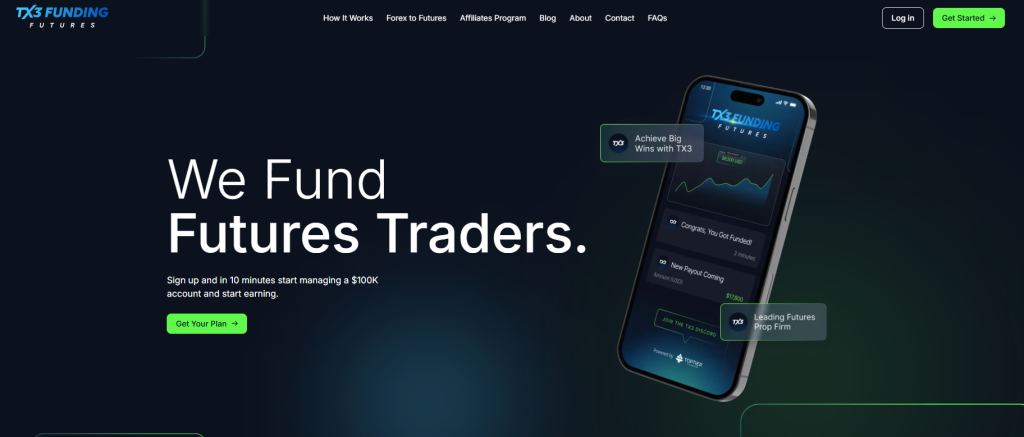
TX3 Funding is one of the most accessible and trader-friendly futures prop firms in 2026. Its simple one-step evaluation, fast payouts, and high profit splits make it particularly attractive to traders who want to scale their futures trading careers without unnecessary delays or red tape.
Futures trading has become an essential tool for traders and investors looking to hedge risk, speculate on price movements, and gain exposure to various asset classes. Unlike traditional stock trading, futures contracts allow market participants to buy or sell an asset at a predetermined price on a future date, providing unique advantages such as leverage, diversification, and the ability to profit in both rising and falling markets.

Volume Profile is a powerful tool that gives traders a deeper insight into market structure by displaying the distribution of trading volume at different price levels. Unlike traditional volume indicators that measure volume over time, Volume Profile helps traders identify key price levels where heavy buying and selling have taken place. This information is invaluable for futures traders, as it highlights areas of strong support and resistance, potential breakout zones, and price levels where large institutional traders may be active. In this comprehensive guide, we’ll break down how Volume Profile works, why it’s useful in futures trading, and how you can incorporate it into your trading strategy.

Futures trading is a dynamic and high-stakes financial market where traders speculate on the future price movements of assets such as commodities, currencies, and stock indices. While the potential for profit is significant, so too is the risk, which can lead to heightened anxiety among traders. This psychological factor is crucial in shaping market behavior and decision-making. The concept of the Anxiety Index in futures trading refers to the collective emotional state of market participants, influenced by volatility, economic indicators, and geopolitical events. Understanding this index can help traders make more informed decisions, manage risk effectively, and develop emotional resilience in the face of market fluctuations.

Moving averages (MAs) are essential tools in technical analysis, providing traders with insights into price trends and momentum. In the volatile futures market, where prices can fluctuate rapidly, moving averages help traders identify trend direction, gauge strength, and pinpoint entry and exit points. Among the most commonly used moving averages are the Simple Moving Average (SMA) and Exponential Moving Average (EMA).

Technical analysis plays a critical role in futures trading, providing traders with insights into price trends, market sentiment, and potential trading opportunities. By analyzing price charts, patterns, and indicators, traders can make informed decisions and manage risks more effectively.

Illiquidity refers to the state of an asset—such as a stock, bond, or other types of investments—that cannot be easily and readily sold or exchanged for cash without incurring a substantial loss in value. Illiquid assets are often characterized by low trading activity, limited market interest, and a lack of willing buyers or sellers. These factors can result in significant financial challenges for investors and businesses alike. This article delves into the concept of illiquidity, its causes, consequences, and implications for individuals, companies, and markets.

Portfolio margin is a sophisticated risk management framework designed to calculate margin requirements based on the overall risk of a trader’s portfolio, rather than applying a fixed margin for each individual position. This approach, widely used in futures trading, offers traders greater leverage and more efficient use of capital, making it particularly appealing to professionals and institutional investors.

Silver, often considered the “poor man’s gold,” has maintained its position as one of the most sought-after precious metals for centuries. From its use in ancient currencies to its applications in modern industries, silver is a versatile commodity with immense value. Today, the silver market offers various instruments for investment and trading, including silver futures. This article delves into the nuances of trading silver futures, exploring their structure, advantages, risks, and key considerations for market participants.